

Transportation Load Analysis of MEGCs using Finite Element Analysis
This project outlines the use of advanced Finite Element Analysis (FEA) to evaluate the structural response of Multiple Element Gas Containers (MEGCs) under representative transportation loads.
FINITE ELEMENT ANALYSIS
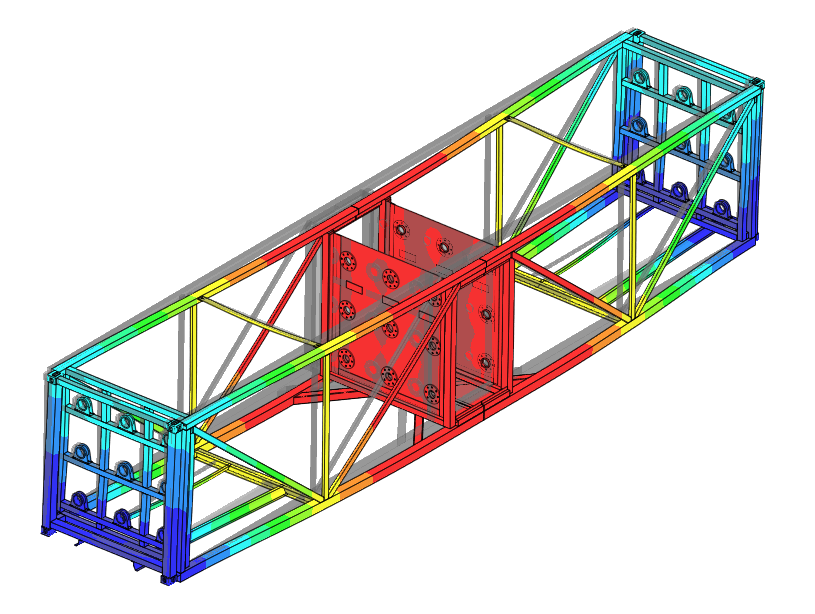
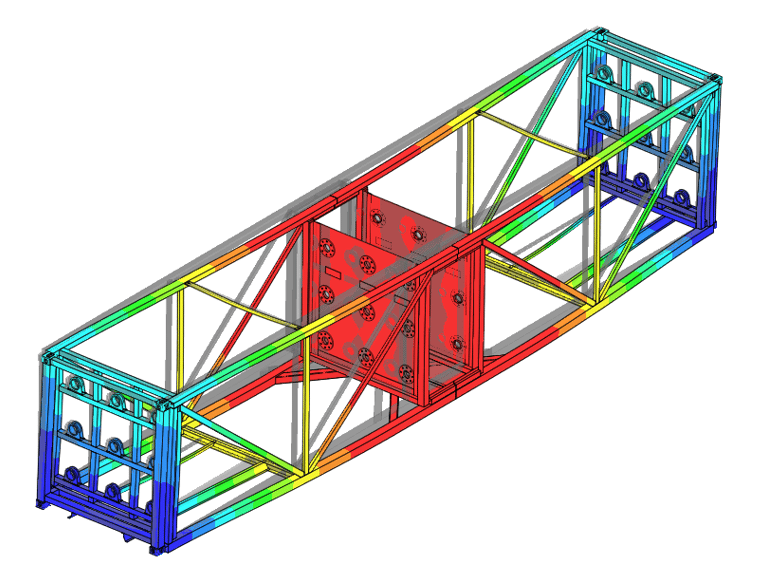
Case Study: Transportation Load Analysis of MEGCs Using Equivalent Static Loads
Project Overview
This project outlines the use of advanced Finite Element Analysis (FEA) to evaluate the structural response of Multiple Element Gas Containers (MEGCs) under representative transportation loads. Equivalent static accelerations derived from applicable international transport standards were applied to ensure structural integrity and compliance with regulatory load requirements.
Objectives of the Study
The primary objective of this case study is to:
Define and apply equivalent static transportation loads for MEGCs based on international regulations
Evaluate stresses and structural response under each transportation load case
Identify critical load cases governing MEGC structural performance
Support design decisions for verification and certification of MEGCs under transportation conditions
Geometry
MEGC System
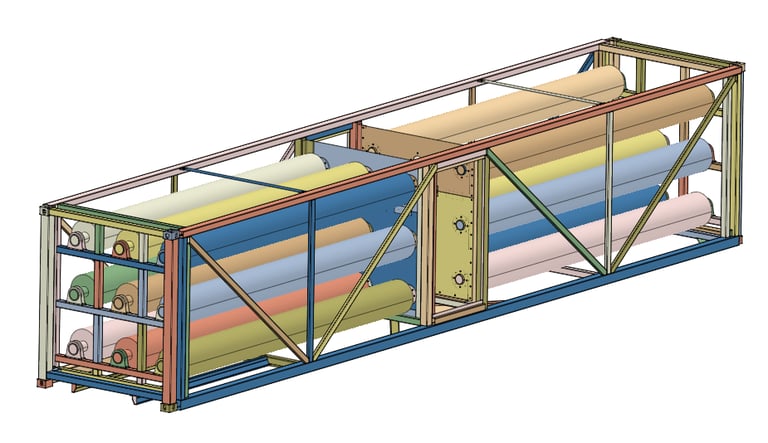
The MEGC assembly modeled in this case study represents a bundle of pressurized gas cylinders mounted within a support frame for road, rail, and maritime transportation. Key geometric features include:
Cylindrical gas cylinders
Welded structural frame
Lifting lugs, tie-down points, and handling interfaces
CAD geometry directly imported into FEA software
Material Properties
Material properties used for the FEA model include:
Elastic modulus (E)
Poisson’s ratio (ν)
Yield strength (Sy)
Mass density (ρ)
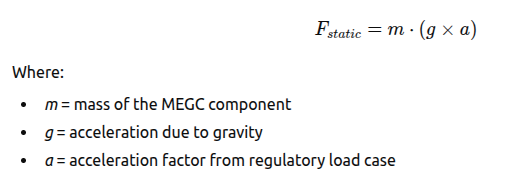
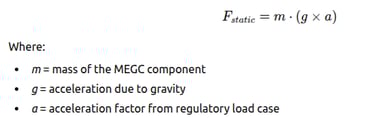
These properties are defined for the frame, cylinders, and connection hardware. Accurate mass properties are necessary to derive equivalent static forces from acceleration factors.
Contact and Structural Modeling
Fully bonded contacts at welded interfaces
Frame and cylinder interfaces modeled to avoid separation under applied loads
Local mesh refinement at lifting points, frame junctions, and supports
Rigid and flexible constraints representing mounting conditions
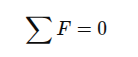
Governing Equations:
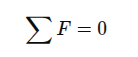
Equilibrium (Static)
Equivalent static forces are applied as body accelerations
Simulation Methodology
Step 1: Geometry Import
MEGC CAD model imported into FEA environment
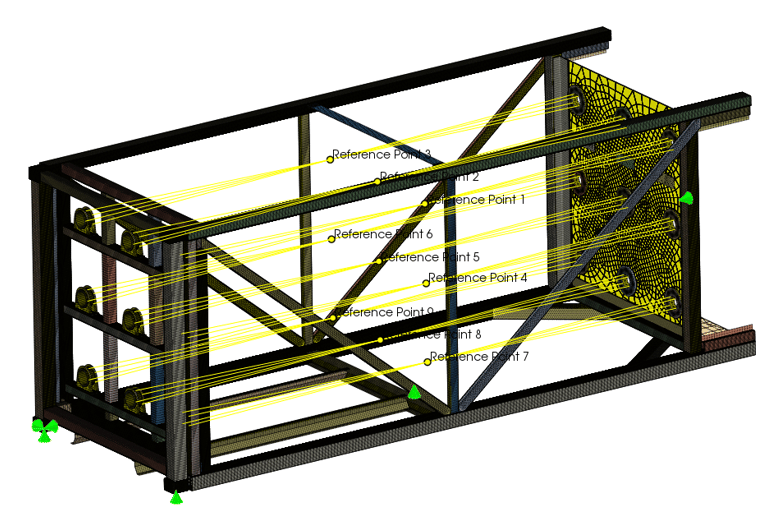
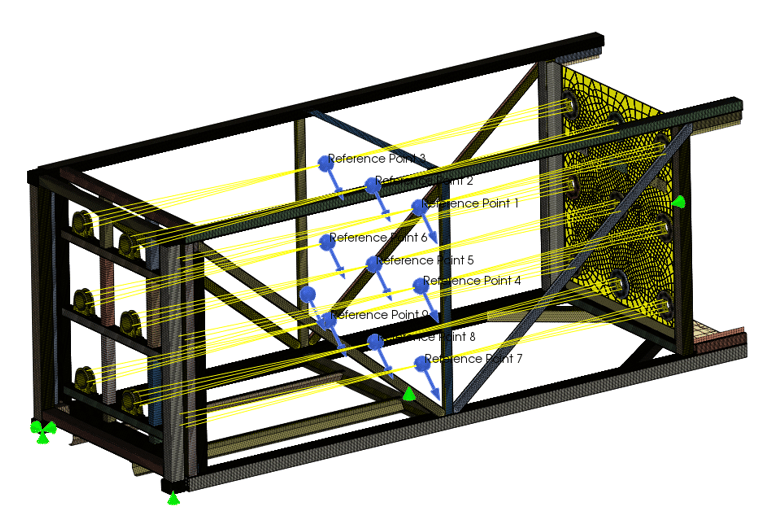
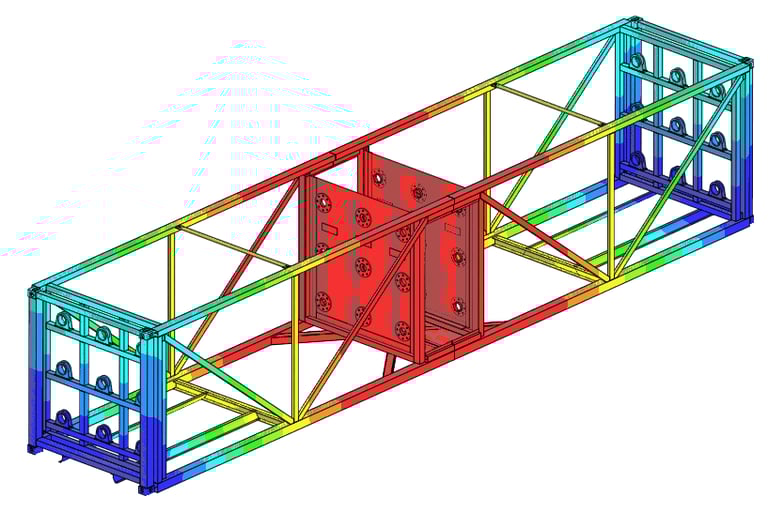
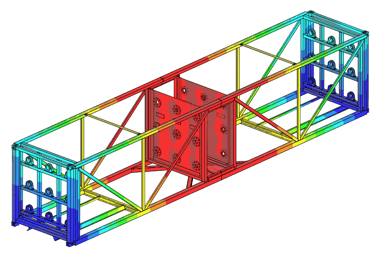
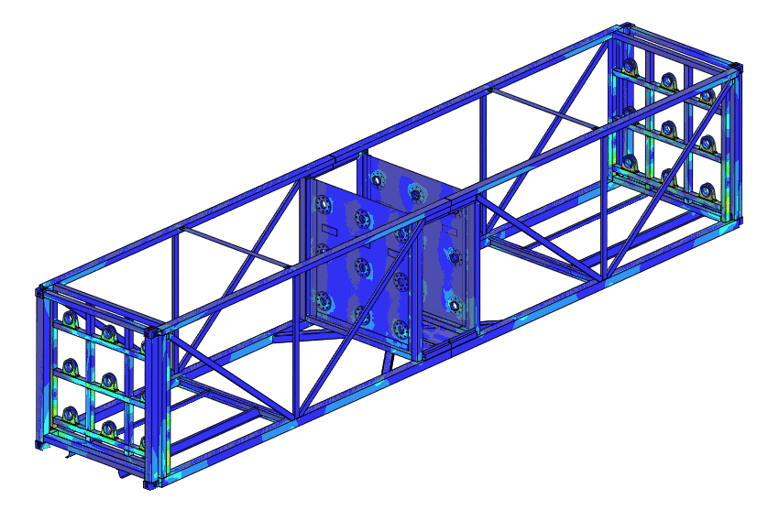
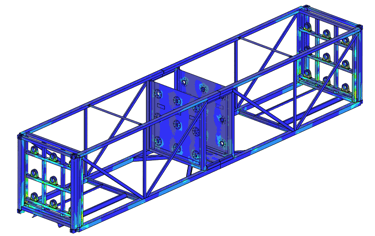
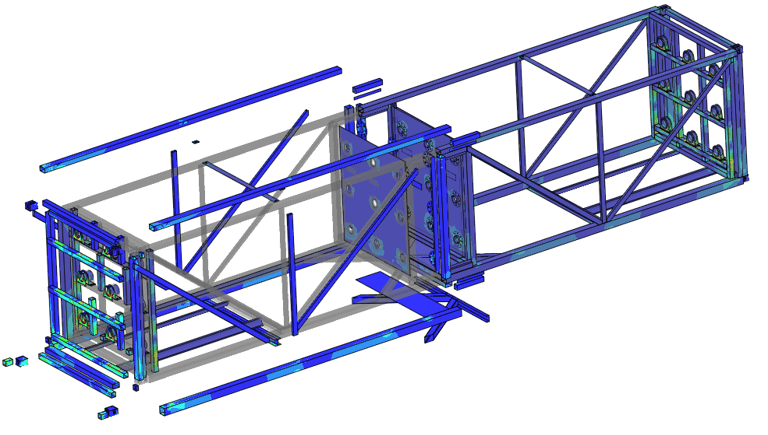
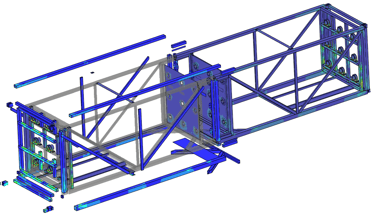
Symmetry was identified per load case (Only lateral load case shown in the images)
For the Longitudinal load case, different symmetry plane was used (entirely different model)
Cylinders were modelled as point masses
Critical load application points identified
Step 2: Meshing
Solid 3D elements used across MEGC and frame
Local refinement at high stress regions
Mesh convergence verified for global and local stress accuracy
Step 3: Load Definition
Equivalent static accelerations applied to body mass
Separate load cases for each transportation direction. The images are shown for lateral direction load case only
Step 4: Boundary Conditions
Mounting restraints applied to simulate transport mountings
Loads applied independently and in critical combinations
Symmetry was also applied to the mid plane.
Step 5: Solver Execution
Linear static analysis performed for each load case
Reaction forces and stress distributions extracted
Post-Processing and Key Results
Key outputs analyzed include:
von Mises stress distributions
Maximum stress regions in support frame and lifting points
Comparison of stress results among load cases
Identification of governing load cases
Results showed that longitudinal braking and maritime combined loads produced the highest stress intensities in the MEGC support frame. All evaluated stresses remain below allowable limits for the selected material properties.
Engineering Insights Gained
Longitudinal and vertical combinations govern structural design
Lifting and handling loads require careful reinforcement at attachment points
Equivalent static approach provides conservative yet practical evaluation
Industrial Applications
Multiple Element Gas Containers (MEGCs)
Transportation load analysis using FEA is critical for MEGC systems used for bulk transport of compressed and liquefied gases. The defined equivalent static load cases ensure structural integrity of the cylinder bundle, frame, lifting lugs, and tie-down points during road, rail, and maritime transportation in compliance with international regulations.
Tube Trailers and Gas Cylinder Transport Systems
Tube trailers transporting high-pressure gas cylinders are subjected to severe longitudinal, lateral, and vertical loads during braking, cornering, and road irregularities. The methodology presented in this study is directly applicable for assessing structural adequacy of tube supports, saddles, trailer frames, and end restraints under transportation loading conditions.
Skid-Mounted Process Equipment
Skid-mounted assemblies such as gas regulation skids, compressor skids, and pressure reduction skids experience similar transportation and handling loads as MEGCs. Equivalent static load analysis ensures that skids, base frames, pipe supports, and equipment anchoring systems remain within allowable stress limits during shipment and installation.
Modular Pressure Equipment and Transport Frames
Modular pressure vessels, ISO frames, and packaged equipment units designed for intermodal transport require verification under combined acceleration and lifting loads. The presented FEA approach supports structural evaluation of transport frames, corner fittings, and lifting points for safe handling and transport.
Hazardous Goods Transportation Systems
For systems transporting hazardous or high-energy contents, including industrial gases and specialty chemicals, transportation load analysis provides a critical verification step. The defined load cases help mitigate risks associated with accidental impacts, handling mishaps, and extreme transport conditions.
Benefits to Industry
Code-aligned structural assessment
Identification of critical transport load conditions
Design guidance for load path reinforcement
Reduced risk of in-service failure during transit
Author Linkedin Profile
+91-9879488468
© 2025. All rights reserved.